Meta is spending your budget on the wrong days. Here's how to move it.
Find the days and hours that convert, then move money there yourself. Break spend and purchases out by weekday and by hour, compare each day's share of spend with its share of purchases, and use Meta's budget scheduling to raise the budget on the days that win. Meta paces evenly; your buyers do not.
Wake up, open Ads Manager, and half the day’s budget is gone with nothing to show for it. Then the weekend arrives, the people who actually buy are scrolling, and the campaign has gone quiet. Most media buyers have felt this. Very few have measured it.
We measured it on the scaling ad set of one of our accounts, a consumer business in India that takes bookings online. The ad set optimises to purchase, and the purchase event fires at the moment someone books. All times below are IST, and Meta reports each purchase against the hour and day the ad was seen.
Is Meta really spending on the wrong days?
On this account, yes, and by a wide margin. Across eleven weeks, from 27 July to 16 October 2026, we lined up each weekday’s share of spend against its share of purchases.
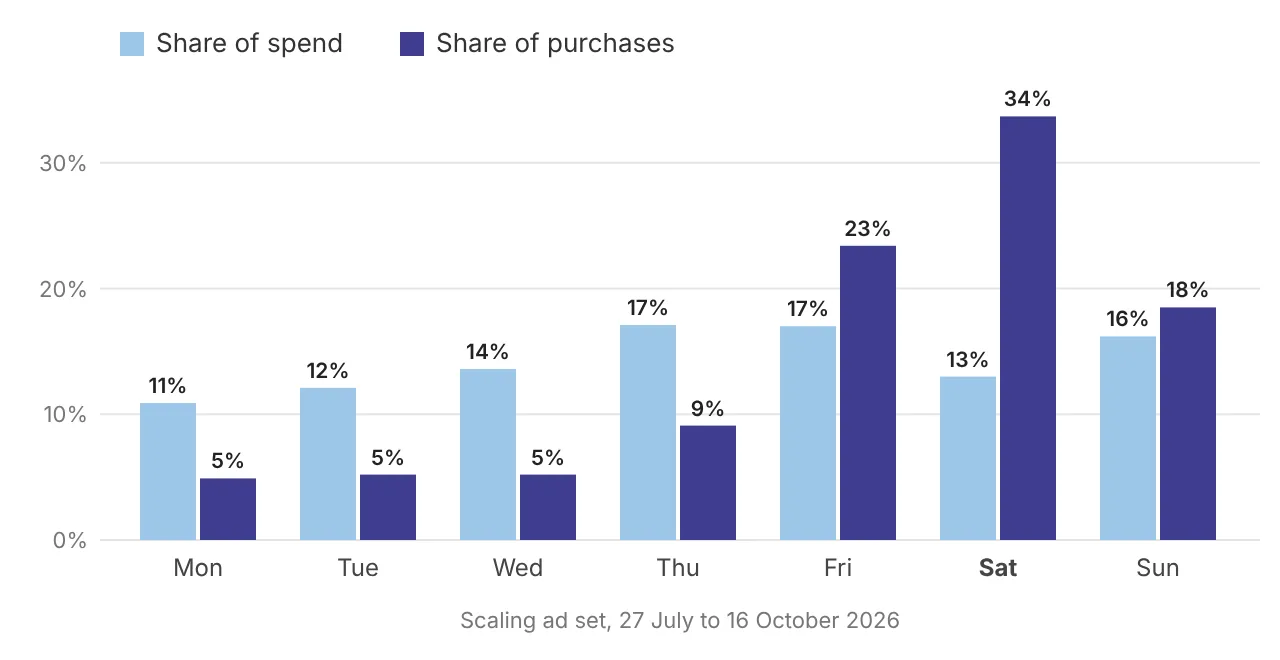
Share of spend and share of purchases by weekday. Source: the account’s Meta Ads Manager data, client anonymised.
| Day | Spend per day | Share of spend | Share of purchases | Cost per purchase | ROAS |
|---|---|---|---|---|---|
| Monday to Wednesday | ₹768 to ₹958 | 37% | 15% | ₹576 to ₹676 | 2.8 to 3.3 |
| Thursday | ₹1,207 | 17% | 9% | ₹483 | 4.4 |
| Friday | ₹1,199 | 17% | 23% | ₹187 | 10.6 |
| Saturday | ₹1,004 | 13% | 34% | ₹99 | 23.2 |
| Sunday | ₹1,249 | 16% | 19% | ₹225 | 8.8 |
Saturday produced a third of all purchases and received the second-smallest budget of the week. Monday to Wednesday together took 37% of the money and returned 15% of the purchases. Before the change, Friday to Sunday took 46% of spend and delivered 76% of purchases.
That is the whole problem in one table. Meta was not wasting money in some dramatic way. It was spreading it evenly across a week where demand is anything but even.
Why does Meta spend less when customers buy more?
Two mechanics, both documented by Meta and both visible in the data.
First, a daily budget is an average. Meta’s own daily budget documentation explains that spend can run above or below the daily figure on any given day, with the system pacing towards a weekly total. Nothing in that pacing knows your Saturday is special.
Second, the auction is dearer when everyone wants the same people. On the Saturdays we checked, the cost per thousand impressions ran from ₹100 to ₹170 through the day and touched ₹337 in one evening hour. On the weekdays we checked it mostly sat between ₹30 and ₹70. A fixed budget buys far fewer impressions on a Saturday, so it runs out sooner.
When in the day does the money run out?
This is where the off-hours complaint becomes concrete. We compared the hourly spread of spend on four ordinary weekdays with three Saturdays before any change.
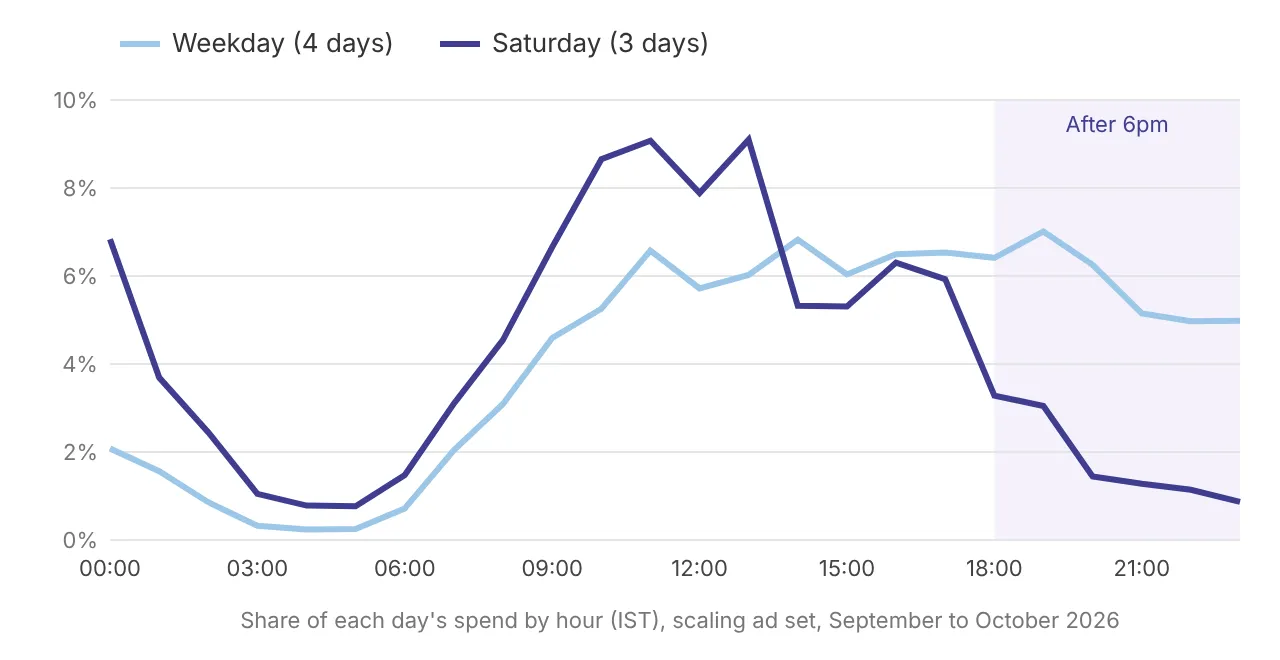
Share of each day’s spend by hour, weekdays against Saturdays. Source: the account’s Meta Ads Manager data, client anonymised.
On weekdays, 35% of the day’s spend went out after 6pm. On Saturdays it was 11%. By 2pm on a Saturday, two thirds of the budget was already gone.
The evening was not dead, though. On those three Saturdays the money spent after 6pm bought 8 of the 34 purchases, at about ₹40 each, against roughly ₹96 each before 6pm. That is a small sample and we treat it as a lead rather than a finding, but it points the same way as the daily numbers: the budget was gone before the cheapest buyers of the day showed up.
One claim we could not confirm is the popular one about half the budget disappearing overnight. On this account, about 21% of spend went out before 10am. Check your own hourly breakdown before you build a strategy on that idea.
How do you move the budget with Meta budget scheduling?
Meta’s budget scheduling lets you raise an ad set or campaign budget for a fixed window, by a percentage or to a set amount, without touching the base budget. We used it in the simplest way possible: a 20% increase on Saturday 10 and Sunday 11 October, and nothing else changed in the ad set.
The steps, for anyone who wants to repeat it:
- Pull at least six weeks of spend, purchases and purchase value by day, and work out each weekday’s share of spend and share of purchases.
- Mark the days where the purchase share beats the spend share by a clear margin. Here that was Friday and Saturday, with Sunday roughly even.
- In the ad set’s budget settings, add a scheduled increase for those days. Start at 20%, so that a wrong call costs little.
- Compare each scheduled day with the same weekday before the change, not with the week average.
- Repeat for several weekends before you raise the base budget or move money out of weekdays.
If you run separate scaling and testing campaigns, as we described in the Meta campaign structure working for us in October 2026, schedule the scaling campaign only. The testing campaign needs steady, even spend to give every new ad a fair read.
What happened when we moved it?
The first scheduled Saturday, 10 October, turned the week upside down. Saturday went from the least-funded day to the most-funded one.
| Saturday average before the change | Saturday 10 October | |
|---|---|---|
| Spend | ₹934 | ₹1,699 |
| Purchases | 9.4 | 17 |
| Cost per purchase | ₹99 | ₹100 |
| ROAS | 22.8 | 25.0 |
Spend rose by 82% and purchases rose by 81%, with cost per purchase unchanged. Extra money on the right day bought customers at the same price as the money already there. On the hourly view, spend held up into the evening: 20% of the day’s money went out after 6pm, against 11% on earlier Saturdays.
Two caveats, because a single weekend proves very little. The ad set was paused on 29 and 30 September and came back spending more every day, so part of that jump is a higher base, not the schedule alone. And Saturday 3 October, part of a long weekend, still did better on its own, with 21 purchases at a ROAS of 48. We are running the same schedule on 16 to 18 October and will update this page with the result.
More on structure and budgets sits under paid media and scaling with ads.
Ask me anything about this post
Frequently asked questions
Why does Meta spend less on the days that convert best?
Because a daily budget is paced as a weekly average, not as a bet on your best day. On busy days the auction gets more expensive: on this account Saturday cost ₹100 to ₹170 per thousand impressions against roughly ₹30 to ₹70 midweek. Meta buys fewer, dearer impressions, the budget runs out by late afternoon, and the evening goes unfunded.
Should I use dayparting instead of budget scheduling?
Only if the hour pattern is stable and large. Dayparting needs a lifetime budget and cuts delivery hard, which can starve the learning phase. Budget scheduling keeps the campaign running every day and adds money on the days that earn it. Start there, and daypart only when an hour is clearly losing money across several weeks.
How much data do you need before scheduling a budget increase?
Enough weeks that the pattern repeats, not one good weekend. This account had ten Saturdays of history before the change. A single strong Saturday can be a holiday, a salary date or a creative that happened to land. Repetition is what makes it a pattern you can budget against.
Does raising the budget on a good day lower its ROAS?
It can, because extra money buys less efficient impressions. On this account it did not, at least on the first scheduled Saturday: spend went up and ROAS stayed at 25, against a pre-change Saturday average of 22.8. One weekend is not proof, so measure every scheduled day against the same weekday before the change.
Sources
- About daily budgets — Meta Business Help Centre, accessed 16 Oct 2026
- About bid and budget pacing — Meta Business Help Centre, accessed 16 Oct 2026
- First-party ad account data, 27 July to 16 October 2026 (client anonymised) — Marxx AI, accessed 16 Oct 2026
Related reading
-
You can now pick age and gender per creative inside one Meta ad set
Meta's new "Choose an audience for each ad creative" lets one ad set aim each creative at its own age and gender. How it works, its limits and when to use it.
-
27 Meta ad formats you've never used, with real examples
Twenty-seven creative formats for Meta ads, from blind tests to notes app ads, each with a real ad that brands kept running for 60 days or more.
-
Your Meta frequency and device reports may be empty without warning
Since 6 August 2026 three Meta Insights breakdowns return no data unless an admin opts the ad account in. Which ones, how to check, and how to fix it.
Ask this site
Answers are generated from published posts on this site only. Check the cited post before acting on anything.