Andromeda 2.0, GEM and GenRecs: what Meta's ad AI means for creative
Andromeda is the system that picks which few thousand ads could suit a person, before GEM ranks them. "Andromeda 2.0" is the industry name for the 2026 version, which scores every eligible ad far more precisely. The lesson for advertisers: genuinely different creative concepts find new people; near-copies of one ad do not.
Every few weeks someone tells you “Andromeda changed everything.” Few explain what Andromeda is, what changed this year, or what you should do differently on Monday. Here is the plain version.
What happens between your ad and a person’s feed?
When someone opens Instagram, Meta has tens of millions of ads it could show them. It cannot score all of them with its heaviest model in a fraction of a second, so it works in stages.
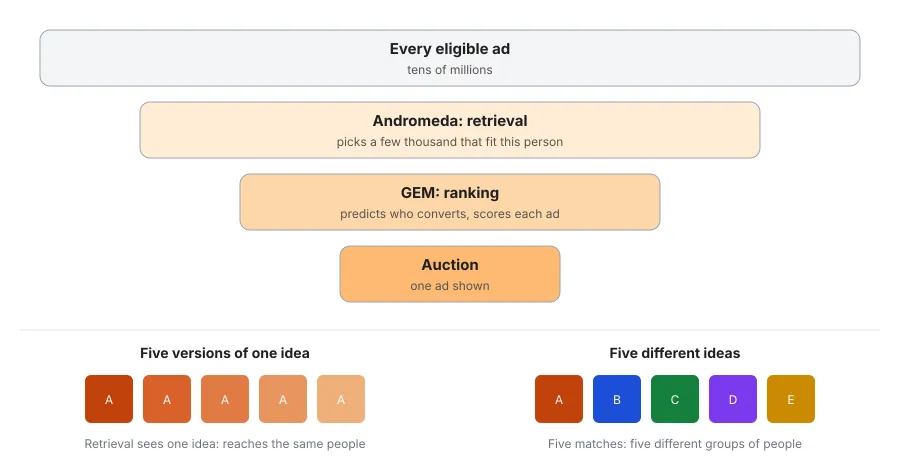
- Andromeda, retrieval. Narrows those tens of millions to a few thousand ads that could suit this person. Meta introduced it in December 2024.
- GEM, ranking. Meta’s Generative Ads Recommendation Model scores those candidates: how likely is this person to click, buy or sign up?
- The auction. Your bid, the score and the competition decide which single ad appears.
Alongside these, Meta runs generative retrieval: instead of only matching ads to a person, it describes the kind of ad that person would respond to, then finds real ads that fit.
The step that matters most for you is the first. If Andromeda never retrieves your ad for someone, nothing you do in bidding or ranking can help.
What is “Andromeda 2.0”?
It is the industry’s name for the next generation of Andromeda, which Meta described on its engineering blog on 28 October 2026. Meta does not use the “2.0” label.
The change, as reported from Meta’s post, is that retrieval now “scores every eligible ad with near ranking-level model performance at retrieval scale.” In other words, the first cut is much smarter. PPC Land reports Meta’s figures of over a billion ads scored per second per GPU server, about 100 times the 2024 rate, and a 2.4% lift in Facebook conversions since 2025. There is no setting to switch on; it simply runs.
Meta’s Q3 2026 results call on 21 October gave more numbers from the same family of systems: improvements to Andromeda lifted conversions on Facebook by 1.4%, generative retrieval by nearly 2% in the segments where it runs, and GEM by 1.7% on off-site conversion campaigns and 9.6% on app ads. These are Meta’s own figures, without method or baselines, so read them as direction rather than proof.
Why does this make creative the targeting?
Because retrieval matches people to ads, and the ad is what it has to match on. Meta said it directly in 2025: the focus has moved from niche targeting to creative diversification, which it defines as “creating a wide range of ad creatives with different themes, messages, and visuals.” And: “The biggest constraint you can put on your Meta strategy is the constraints you place on your creative process.”
A smarter retrieval system rewards this even more. Each genuinely different concept is a new way to match a different group of people. Five versions of one idea, the same video in five colours, give retrieval one idea to work with. Five different ideas give it five.
Many guides go further and say Meta groups near-identical ads together and treats them as one, with precise similarity thresholds. We found no Meta statement confirming that, so we would not plan around the numbers. The practical point stands either way: near-copies do not reach new people.
What should you do differently?
Count concepts, not ads. A concept is a different angle, person, problem, format or offer. A colour swap, a new headline on the same video or a cropped version is the same concept. A quick test: if you can describe every live ad in one sentence, you have one concept, not twenty.
Make enough of them. In our accounts we aim for 20 to 25 genuinely different concepts in each campaign or ad set. Smaller budgets may need fewer, because each concept needs spend to be tested, but the direction is the same. 27 Meta ad formats you’ve never used is a good place to find new ones.
Fewer ad sets, more concepts in each. Give retrieval one well-funded ad set with many distinct creatives rather than many ad sets with one or two each. Our post on Meta’s 50 conversions a week shows how to work out how many ad sets your budget can feed.
Let the data tell you which concept to grow. Use the creative asset breakdown to see which concept Meta backs, then brief more versions of that idea, while still adding new ones.
Keep targeting broad. With retrieval this good, narrow audiences mostly limit what Meta can find. Set the few hard limits that still matter, as in what’s left of Meta targeting, and let the creative do the rest.
Andromeda is not a setting, a campaign type or a trick. It is Meta getting better at matching ads to people. The way to benefit is to give it more genuinely different things to match.
Ask me anything about this post
Frequently asked questions
Is Andromeda 2.0 an official Meta name?
No. Meta calls it the next generation of Andromeda, described in its engineering blog on 28 October 2026. "Andromeda 2.0" is the name the industry uses for it.
What is the difference between Andromeda and GEM?
Andromeda does retrieval: it narrows tens of millions of eligible ads to a few thousand that could suit a person. GEM, Meta's Generative Ads Recommendation Model, does ranking: it predicts which of those the person is likely to act on.
Does Andromeda treat similar ads as one ad?
Many guides say so and quote similarity thresholds, but we found no Meta statement confirming it. What Meta does say is that it wants a wide range of creatives with different themes, messages and visuals.
How many creative concepts should I run?
In our accounts we aim for 20 to 25 genuinely different concepts in each campaign or ad set. Count concepts, not variations: a colour swap is the same concept. Smaller budgets may need fewer, because each concept needs spend to be tested.
Sources
- Meta Andromeda next-gen ads retrieval — Engineering at Meta, accessed 10 Nov 2026
- Meta Andromeda: Advantage+ automation's next-gen personalized ads retrieval engine — Engineering at Meta, accessed 10 Nov 2026
- The Creative Advantage: unlocking the power of diversification with Meta Andromeda — Meta for Business, accessed 10 Nov 2026
- Meta says Andromeda lifted Facebook conversions 2.4% since 2025 — PPC Land, accessed 10 Nov 2026
- Meta Andromeda and creative diversification — Jon Loomer Digital, accessed 10 Nov 2026
Related reading
-
Meta's creative diversity score: what Low, Medium and High mean
Ads Manager now rates each ad set's creative diversity as Low, Medium or High. How it is worked out, what it misses, and how much to care.
-
How to think about a restaurant logo and its design system
A restaurant logo starts with the name, not a fork and knife. How we decode a name into one idea, then build the colours, fonts and packaging around it.
-
You can now pick age and gender per creative inside one Meta ad set
Meta's new "Choose an audience for each ad creative" lets one ad set aim each creative at its own age and gender. How it works, its limits and when to use it.
Ask this site
Answers are generated from published posts on this site only. Check the cited post before acting on anything.