Meta's creative diversity score: what Low, Medium and High mean
It is an estimated rating, Low, Medium or High, that Meta gives each ad set by comparing how visually similar its images and video thumbnails are. It ignores copy and does not change delivery. Use it as a nudge to add genuinely different concepts, not as a number to chase.
Since late August 2026, Ads Manager has a new column that grades each ad set’s creative: Low, Medium or High. Add it to your account and the first thing you will probably see is a row of Lows. That is what we see in most of our accounts, including ad sets we would call varied.
Here is what the score measures, what it misses, and how much attention it deserves.
Where is it?
At ad set level. In Ads Manager, open Columns, then Customise columns, search for Creative diversity and add it. Meta labels it as estimated and in development.
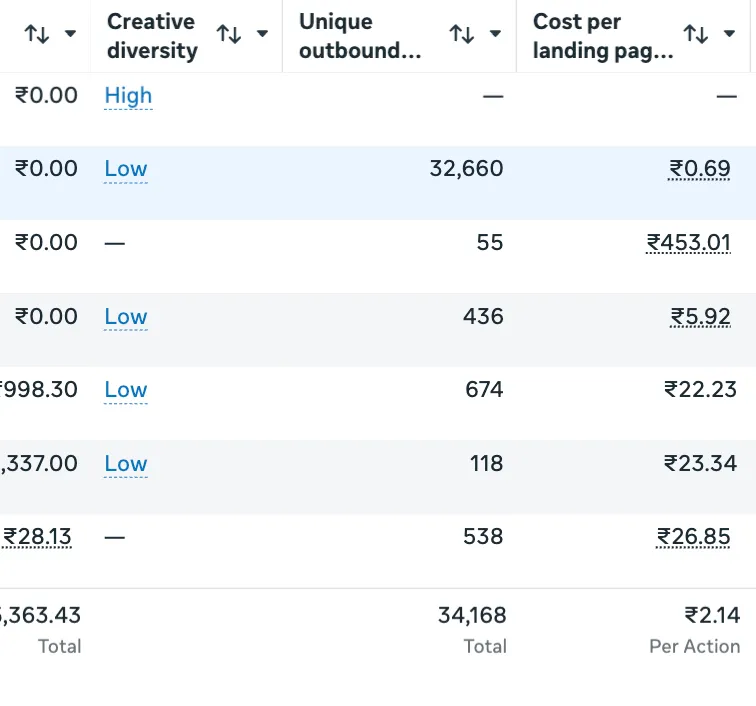
This is how it looks on one of our accounts: one High, four Lows and two dashes, where the column shows no rating. Notice the ad set with the cheapest landing page views, ₹0.69 each, is rated Low.
How does Meta work it out?
Meta’s own description, as quoted by several guides that cite its Help Centre, is that the score “compares the images and video thumbnails in an ad set to each other to determine similarity, converts that into a score, and gives the ad set a High, Medium or Low label by applying thresholds.” The point, Meta says, is to show when an ad set needs more varied images and videos.
Three things follow from that:
- It is visual only. Headlines, primary text and calls to action are not part of it. Two ads with very different messages but the same look score as similar.
- Video is judged by its thumbnail. Five different videos that open on a similar frame, a person talking to camera against a plain wall, can read as one.
- The thresholds are secret. Meta has not said how similar is too similar.
Does it change delivery?
Meta has not said that it does. It is a rating, not a setting. Some blogs claim a Low score means Meta shows your ads less, or quote exact similarity percentages; none of them show evidence, and we would not plan around those numbers.
What is true is the idea behind it. Meta’s Andromeda retrieval matches people to ads, so genuinely different concepts reach different people and near-copies do not. The score is Meta’s rough, visual-only way of telling you whether you are giving it enough to work with.
Should you chase a High score?
No. In our accounts, most ad sets show Low, and the score does not line up well with which ad sets actually perform. It is easy to push the number up with visual tricks that change nothing about who the ad reaches: a new background colour, a different crop, a sticker. That makes the column happier and the account no better.
Use it as a nudge instead:
- When an ad set shows Low, look at the creatives side by side. If they really are one idea in different colours, the score is right. Add new concepts: a different angle, person, problem or format. 27 Meta ad formats you’ve never used has plenty.
- Change the opening frame, not just the content. If your videos all start the same way, give each a distinct first frame. It helps the score, and more importantly it helps the hook.
- Track it next to results, not instead of them. Note the score alongside cost per result and frequency each week. If a Low ad set is holding its cost per result, leave it alone.
- Judge concepts with the asset data. The creative asset breakdown tells you which concept Meta is actually backing, which is worth more than any label.
The score is a crude measure of a real problem. Treat the problem, which is too few genuinely different ideas, and ignore the temptation to game the label.
Ask me anything about this post
Frequently asked questions
Where do I find the creative diversity score?
It is an optional column at ad set level. In Ads Manager, open Columns, then Customise columns, and add Creative diversity.
How does Meta calculate creative diversity?
Meta's description, as quoted by several guides, is that it compares the images and video thumbnails in an ad set to each other, turns the similarity into a score and labels it High, Medium or Low. Meta marks it as estimated and in development, and has not published the thresholds.
Does a Low score reduce my ad delivery?
Meta has not said so. The score is advisory. Some blogs claim Low means less reach, but none of them show evidence.
Why does my ad set show Low when I use different formats?
Because it judges how the visuals look, not the format. Videos that open on similar frames, or images with the same layout and colours, read as similar even if one is a reel and one is a static.
Sources
- Meta Ads Manager introduces creative diversity score — Marketing Concurrent, accessed 10 Nov 2026
- Meta creative diversity score — Roashack, accessed 10 Nov 2026
- The Creative Advantage: unlocking the power of diversification with Meta Andromeda — Meta for Business, accessed 10 Nov 2026
Related reading
-
Andromeda 2.0, GEM and GenRecs: what Meta's ad AI means for creative
What Meta's ad systems Andromeda, GEM and generative retrieval actually do, what changed in 2026, and why distinct creative concepts now beat more ads.
-
How to think about a restaurant logo and its design system
A restaurant logo starts with the name, not a fork and knife. How we decode a name into one idea, then build the colours, fonts and packaging around it.
-
Meta shows results per creative asset. Here's how to read it.
Ads Manager's Creative breakdown shows results for each image, video and headline. How to find it, what it hides, and when to act on it.
Ask this site
Answers are generated from published posts on this site only. Check the cited post before acting on anything.